
Insulin - Once a week : Dream come true?
D-Coding the article : Once-weekly insulin icodec versus once-daily insulin degludec as part of a basal-bolus regimen in individuals with type 1 diabetes (ONWARDS 6): A phase 3a, randomized, open-label, treat-to-target trial.
Published Date:
2023, Oct 17
Published By:
David Russell-Jones , Tetsuya Babazono, Roman Cailleteau, Susanne Engberg, Concetta Irace, Maiken Ina Siegismund Kjaersgaard, Chantal Mathieu, Julio Rosenstock, Vincent Woo, David C Klonoff
Approved By:
To be

Decoded By:
Asra H. Ahmed
MBA, PGCE in Assessment Learning disability, Head of Education at The Diabesties Foundation.
5 mins to read
- The T1D Takeaway
- Bottom line in this adult type 1 diabetes trial, once-weekly icodec lowered HbA1c about as much as once-daily degludec at 26 weeks but combined clinically significant or severe hypoglycaemia occurred more often with icodec. The research supports convenience as a possible benefit, with hypoglycaemia as the central trade-off.
Summary Snap
Shots
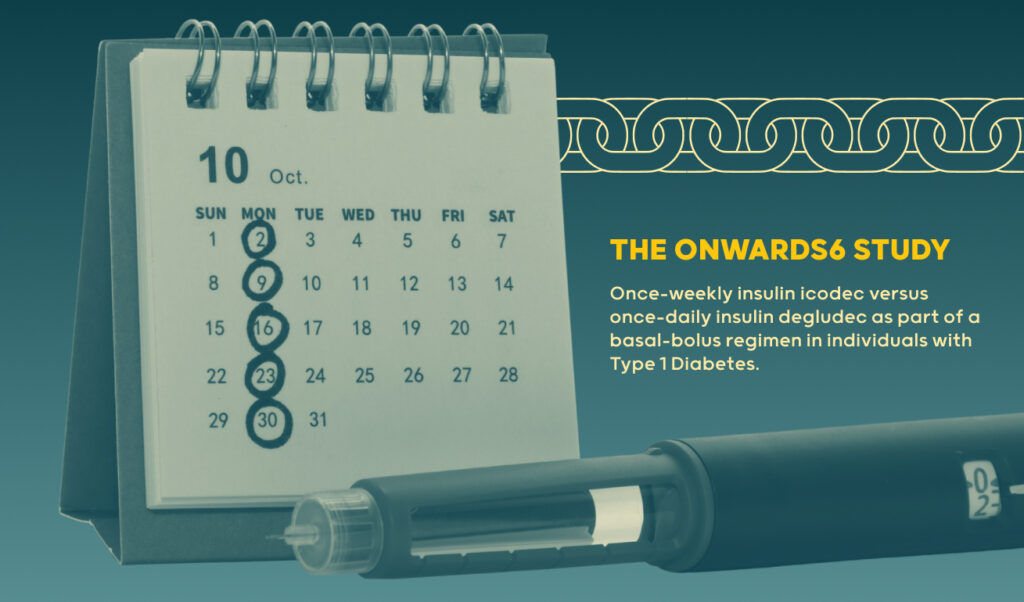
Research in one sentence ONWARDS 6 showed non-inferior HbA1c reduction with once-weekly icodec at week 26, alongside a statistically significant increase in combined clinically significant or severe hypoglycaemia compared with once-daily degludec.
582 | 52 weeks | 0.05% | 1.9× |
adults randomised | 26-week main phase + safety extension | week-26 HbA1c treatment difference | rate ratio for level 2/3 hypoglycaemia |
At week 26, icodec met the study’s non-inferiority test for HbA1c reduction. It did not prove superior glucose control. The main safety signal was a statistically significant increase in combined clinically significant or severe hypoglycaemia. That higher hypoglycaemia rate was also seen when the investigators assessed the full 57-week period, comprising 52 weeks of treatment plus 5 weeks of follow-up.
Prime Insight
Type 1 diabetes basal-bolus therapy commonly requires daily basal insulin alongside rapid-acting insulin for meals. ONWARDS 6 investigated whether a once-weekly basal insulin could reduce basal injection frequency while providing glucose lowering that was not clinically worse than once-daily degludec. Because a weekly insulin has a prolonged action, efficacy had to be considered alongside hypoglycaemia safety.
- 655 adults were screened; 582 were randomised.
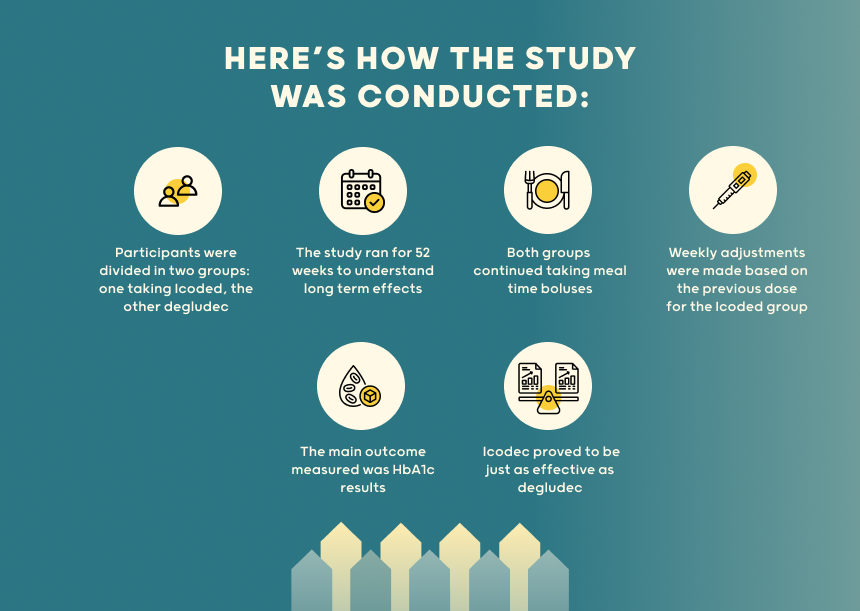
- 290 participants received once-weekly icodec and 292 received once-daily degludec.
- The study ran at 99 sites in 12 countries.
- All participants had type 1 diabetes, were using multiple daily injections and had HbA1c below 10.0% (86 mmol/mol).
- Both groups continued insulin aspart for meals and corrections.
ONWARDS 6 was a phase 3a, randomised, open-label, treat-to-target trial. The 26-week main phase was followed by a 26-week safety extension and a 5-week follow-up. The primary endpoint was change in HbA1c from baseline to week 26. Non-inferiority was tested using a 0.30 percentage-point margin. The study was funded by Novo Nordisk.
One basal injection for seven days that had same blood sugar as using degludeg, BUT there was 1.9× higher incidence of hypoglyeemia recorded among some people living with type 1 diabetes .

OUTCOME | ICODEC | DEGLUDEC | WHAT IT MEANS |
Baseline HbA1c | 7.59% | 7.63% | Groups began at similar average HbA1c. |
HbA1c change, week 26 | -0.47 percentage points | -0.51 percentage points | Estimated difference 0.05 points (95% CI -0.13 to 0.23); icodec met non-inferiority, p=0.0065. |
Level 2/3 hypo rate, weeks 0–26 | 19.9 events per patient-year | 10.4 events per patient-year | Rate ratio 1.9 (95% CI 1.5 to 2.3), p<0.0001: a statistically significant safety signal. |
Level 2/3 hypo, full assessment | Significantly higher over 57 weeks | Lower comparator rate | The difference persisted across 52 treatment weeks plus 5 weeks of follow-up. |
Serious adverse events | 39 events in 24 people (8%) | 25 events in 20 people (7%) | Overall proportions were similar; one death in the icodec group was judged unlikely to be treatment related. |
- Icodec achieved the HbA1c objective, while degludec had the lower rate of clinically significant/severe hypoglycaemia.
- Non-inferior does not mean superior: the week-26 HbA1c difference was small and within the study margin.
- Event rate and time-below-range answer different questions: the study could show a higher number of hypo events even while average percentage time below 54 mg/dL stayed around the international ceiling.
Once-weekly insulin icodec reduced HbA1c to a similar degree as once-daily degludec at 26 weeks in adults with type 1 diabetes, meeting the trial’s non-inferiority criterion. Its potential advantage is reduced basal injection frequency. The central concern is safety: combined clinically significant or severe hypoglycaemia occurred at almost twice the rate with icodec. The paper therefore presents a balanced result—effective HbA1c reduction with a higher hypoglycaemia burden.
- Refine transition and titration approaches that preserve the convenience of weekly basal insulin while reducing clinically significant hypoglycaemia.
- Establish which adults with type 1 diabetes are most likely to benefit from reduced basal injection frequency.
- Confirm safety and effectiveness beyond the 52-week treatment period and outside a structured treat-to-target trial.
- Study populations not included in this adult trial before extending its conclusions to them.
- A Deeper Dive
- The Sources Voice
Research and advocacy of this type is essential to put us in the best position to ensure that children, already living in challenging circumstances, do not get lost or disadvantaged in these societal discussions and changes happening right now.
- Curiosities Clarified
No. It met the non-inferiority test at 26 weeks. The trial showed it was not meaningfully worse within the pre-set margin; it did not establish superiority.
No. Icodec is basal insulin. People with type 1 diabetes still require rapid-acting insulin for meals and corrections.
During weeks 0–26, the rate was 19.9 events per patient-year with icodec and 10.4 with degludec: a rate ratio of 1.9.
Yes. The paper reports a statistically significantly higher rate with icodec when the full 57-week assessment period was analysed.
Serious adverse events were reported in 24 participants (8%) receiving icodec and 20 participants (7%) receiving degludec.
They measure different things. Event rate counts episodes over exposure time; CGM time below range measures the percentage of monitored time spent below the threshold.