
Type 1 diabetes isn’t just about sugar anymore—and honestly, many of us have felt this before science caught up
D-Coding the article : Metabolic health in people living with type 1 diabetes in Belgium: a repeated cross‑sectional study.
Published Date:
24 July 2024
Published By:
Astrid Lavens, Christophe De Block, Michel Vandenbroucke · An‑Sofie Vanherwegen of the IQED Group of Experts, Philippe Oriot, Laurent Crenier, Jean‑Christophe Philips, Frank Nobels, Chantal Mathieu on behalf of on behalf
Approved By:
To be

Decoded By:
Asra H. Ahmed
MBA,PGCE in Assessment Learning disability,
The Diabesties Foundation.
5 mins to read
- The T1D Takeaway
- This study is putting data behind what people living with T1D are already experiencing. Yes, numbers like HbA1c and cholesterol are improving—but at the same time, more of us are dealing with weight changes, insulin resistance, and heart-related risks.
- We might be doing everything “right,” seeing better glucose numbers… and still feel like our body is working harder. That’s not my imagination it’s our reality.
- This study highlights: diabetes isn’t just about managing highs and lows anymore. It’s about understanding the bigger picture—how our body handles insulin, how our weight, blood pressure, and lipids interact, and how all of this affects the long-term health.
- Although the study was based in Belgium the results can be applied to other demographics.
Word Wizard
- Over 20 years of real-world data (26,000+ people) shows real progress—better sugar levels and improved cholesterol—but new challenges are also emerging.
- More people with Type 1 diabetes are now gaining weight (especially around the stomach), experiencing higher pressure in the body, and developing unhealthy fats in the blood—changes once linked to Type 2 diabetes.
- These combined changes are linked to higher risks—more complications affecting the eyes, nerves, kidneys, and heart, even when sugar levels look better.
- This is a big shift. Type 1 diabetes care now needs to look at the whole body weight, heart health, and how the body responds to insulin—not just glucose numbers.
Summary Snap
Shots
HbA1c improved, LDL improved, Obesity increased, Insulin resistance increased, Metabolic syndrome increased (50%), Complications significantly higher with metabolic abnormalities.
Glucose control alone is not enough
Prime Insight
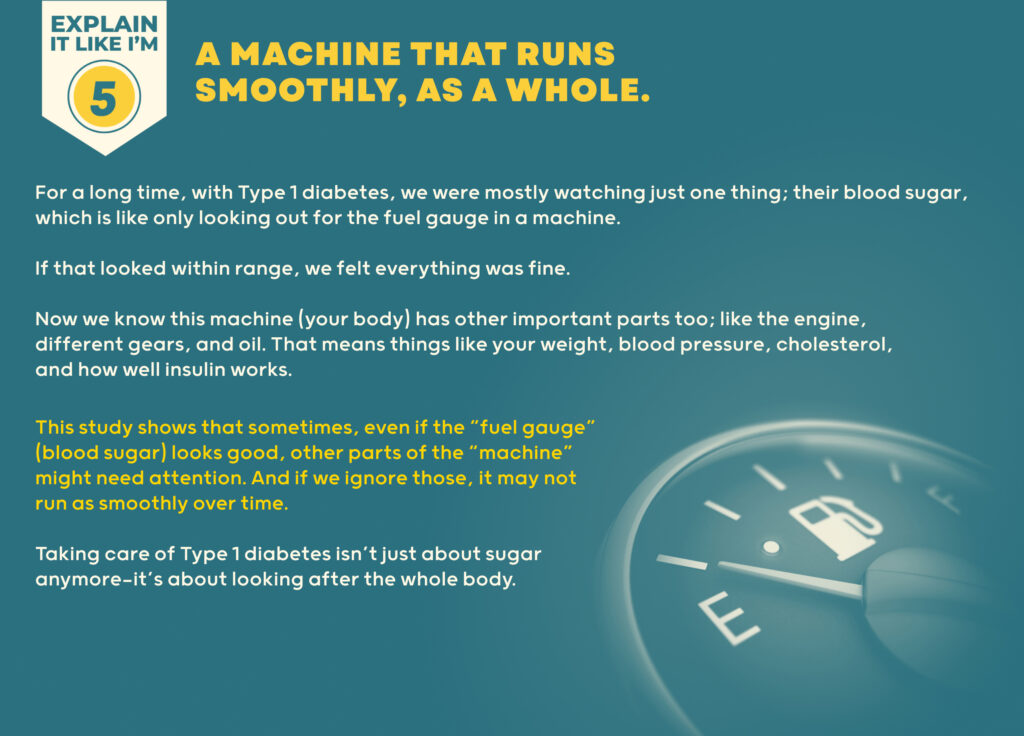
This study shows us something important—Type 1 diabetes is not the same as it used to be. For many years, care focused mainly on managing blood sugar. Yes, we’ve made progress there. People are achieving better glucose levels and better cholesterol control than before, but at the same time, the body is changing in new ways.
More people are gaining weight, especially around the stomach. The body is becoming less sensitive to insulin, meaning it must work harder to do the same job. There is also more strain on the heart and blood vessels.
T1D is changing. Better sugars—but worse metabolic health. The hidden risk? Weight, blood pressure, and lipids quietly increasing complication risk. It’s time to look beyond HbA1c.
These changes are not small—they are strongly linked to real outcomes. People with these patterns are more likely to experience eye changes, nerve problems, kidney issues, and heart disease.
Why does this matter? Because outcomes follow patterns—not just numbers. Individuals with combined metabolic abnormalities showed:
- Higher HbA1c levels despite treatment. Markedly lower insulin sensitivity. Significantly higher rates of microvascular complications (retinopathy, neuropathy, kidney disease). Increased cardiovascular disease risk.
- Crucially, these associations persisted even after adjusting for HbA1c and smoking. This tells us something powerful: Good glucose control alone is no longer enough to fully protect against complications.
Good glucose ≠ low risk anymore. This study shows heart and complication risks rising in T1D despite improved HbA1c. The real story? Metabolic health matters.
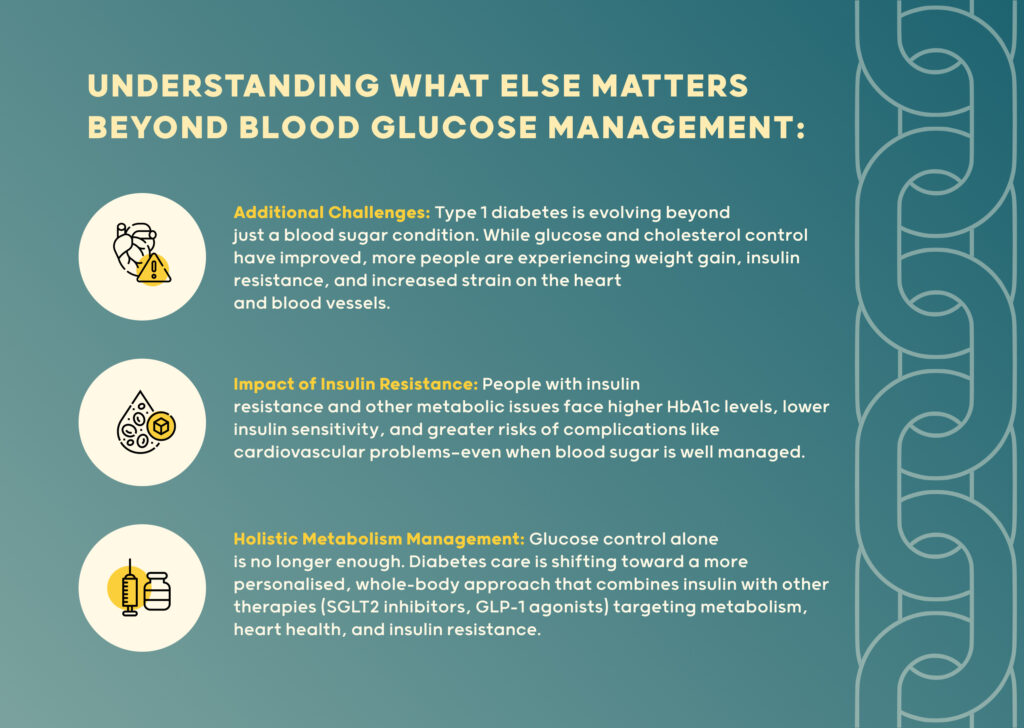
Another important insight is therapeutic adaptation. Clinicians are increasingly using adjunct therapies (metformin, SGLT2 inhibitors, GLP-1 agonists) in T1D—not as standard of care, but as a response to insulin resistance and cardiometabolic risk. This reflects a real-world shift toward individualized, physiology-driven care.
Type 1 diabetes is evolving – The phenotype is changing, influenced by lifestyle, environment, and therapy itself. Complication risk is multifactorial – Glucose is one piece, not the whole story. Education must evolve – People living with T1D need tools to understand weight, insulin resistance, and cardiovascular risk—not just carb counting.
The future of Type 1 diabetes care lies in integrated metabolic management—where insulin is just one part of a broader, person-centered strategy.
Half of adults with T1D now have metabolic risk clusters: Insulin resistance, weight gain, and heart risk factors are rising—blurring the lines with Type 2. The shift is real. The question is—are we still treating T1D like it’s 1990?
- A Deeper Dive
- The Sources Voice
“The presence of combined metabolic abnormalities… was strongly related to the presence of eye complications, peripheral neuropathy, chronic kidney disease and cardiovascular disease.”
- Curiosities Clarified
Because other factors—like weight, blood pressure, and cholesterol—also drive complications.
Not exactly—but there is overlap in metabolic features.
Lifestyle changes, insulin therapy effects (weight gain), and aging population.
13 Comments
Great variety of games and the app doesn’t lag at all. I’ve managed to hit a few nice streaks here lately. Highly recommended for anyone in PH. 9ajilicasino
Great variety of games and the app doesn’t lag at all. I’ve managed to hit a few nice streaks here lately. Highly recommended for anyone in PH. 9ajilicasino
I’ve been looking for a reliable spot and this one really delivers. The interface is smooth and everything loads quickly. Definitely worth a try! phjljl22
I’ve been looking for a reliable spot and this one really delivers. The interface is smooth and everything loads quickly. Definitely worth a try! phjljl22
Such a fun platform with plenty of options to keep you entertained. I spend most of my free time on yoyogame777
Such a fun platform with plenty of options to keep you entertained. I spend most of my free time on yoyogame777
The payouts are surprisingly fast and the games are top notch. Highly recommend checking out winbet289win if you want a reliable spot.
The payouts are surprisingly fast and the games are top notch. Highly recommend checking out winbet289win if you want a reliable spot.
kUYWslHMSzbmzccmUkZVx
acrmsfcRoXaPKJxFm
There is visibly a bunch to realize about this. I consider you made some good points in features also.
cwzquYtYpXeDptgFKkf
lZSkncrybTDrlSoxnZS